
LONDON — Francesca Salih has spent decades working as a personal stylist for high net worth clients, from Silicon Valley to the Middle East, and while she loves the job there was always one element that annoyed her: the clunky technology.
Salih spends her days creating looks for clients, connecting with luxury brands, attending trunk shows and ordering fashion before it lands in-store. She creates mood boards and stylish backdrops and works much like a glossy magazine editor would, putting together shoppable pages for VIP customers.
But to create those pages, she and other stylists have been using cutout photos and scraping images from the internet, which they assemble in a PDF file for clients. The pages aren’t interactive, and the client often has to call the stylist back or screenshot their picks before texting their order.
“Stylists have evolved, but the tools we use are so outdated,” Salih said in an interview, adding, “We’re delivering a luxury service, working with orders that are tens of thousands of pounds,” but the presentation and delivery system are far from luxurious.
“There is also room for miscommunication and missed orders, especially when the stylist is working with multiple clients at a time,” said Salih, who this week will launch a B2B mobile app called Stylegrid.
The Stylegrid homepage. The app aims to streamline the work of stylists and personal shoppers.
The app houses an operating system that uses AI technology to help stylists, and others, curate glossy magazine-grade product pages, which they can send as links over email or text. Clients add their favorite looks to the cart and pay for everything with a click.
“I haven’t built tech for the sake of it. I’ve done this work for 20-plus years, and wanted to change the way we work,” she said. “Only a stylist could have built this app.”
Salih has been building and trialing Stylegrid for the past five years, tapping fellow stylists, personal shoppers, retailers and digital curators across a variety of sectors, such as interior design, to test it ahead of launch.
She’s been bankrolling it herself and is now seeking external funding. “I’ve spent so many years and so much time and money on this, and I believe the opportunities are endless. Now is the time to get that investment,” she said.
Stylegrid is the latest platform that’s helping power the digital creator economy, which is expected to reach $310 billion this year, according to Grand View Research. But it is different from platforms such as LTK and ShopMy because it is not consumer facing and no affiliates are involved.
Instead, the app wants to help stylists and personal shoppers save time and communicate more effectively with clients.
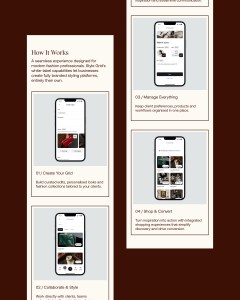
A user’s guide to Stylegrid.
Salih said the app also helps stylists create looks directly on models. Using AI, interior designers can dream up entire homes or office spaces and their clients can browse and buy products from the grid on the same page.
“None of this is replacing the human,” Salih said. “It’s just a way to help the stylist who’s working with multiple clients at once. I really wanted to give something — and especially time — back to creatives.”
Retailers trialing Stylegrid include the tailored clothing brand Thom Sweeney.
Thom Sweeney’s sales floor staff can curate looks from the shop floor and create a grid. Clients choose what they want and pick up clothing directly from the store, or have it delivered, with payments done directly or through the app.
The plan works on a subscription model and costs from 49.99 pounds or 99.99 pounds a month, depending on how many grids the stylist or retailer sends out, and how many “spins,” or different combinations of outfits, users ask AI to create.
The app was conceived as a white label service, so stores and individuals can use their own branding, while all the end-consumer sees is a curated, shoppable page.
Salih said her aim is to evolve Stylegrid into a “discovery” and storytelling platform for stylists like her who travel the world and find treasure in vintage stores, open air markets and small independent shops. Those stylists can create their own grids — not just for personal clients but for anyone interested in following them.
“When you tell a story, product sells,” said Salih, adding that all of her edits for clients start with questions, such as “‘Who am I? What company do I work for? Where am I eating and drinking? What is the smell in the air? Is it hot or cold outside?’ You’re never just selling one product at a time, you’re selling through storytelling,” she said.